When children are taught arithmetic algorithms, they are typically taught them as procedures: a sequence of steps to be followed in order, producing the correct result when correctly executed. The steps themselves are rarely explained. They are demonstrated, practiced, and expected to be retained.
This approach produces children who can execute algorithms correctly when they remember the steps and cannot execute them when they do not, because there is nothing beneath the steps to fall back on. The algorithm is not understood as a consequence of something more fundamental. It is simply a sequence that has been memorized.
The something more fundamental that explains every arithmetic algorithm, and that gives children the resources to work flexibly without a memorized algorithm when one is not available, is a set of three mathematical properties: the commutative property, the associative property, and the distributive property.
These properties are not arbitrary rules. They are descriptions of how numbers actually behave, verified through mathematical proof, and their consequences pervade every calculation a child will ever encounter. A child who genuinely understands them has access to the structural logic of arithmetic in a way that a child who only knows the algorithms does not.
The Commutative Property: Order Does Not Matter for Addition and Multiplication
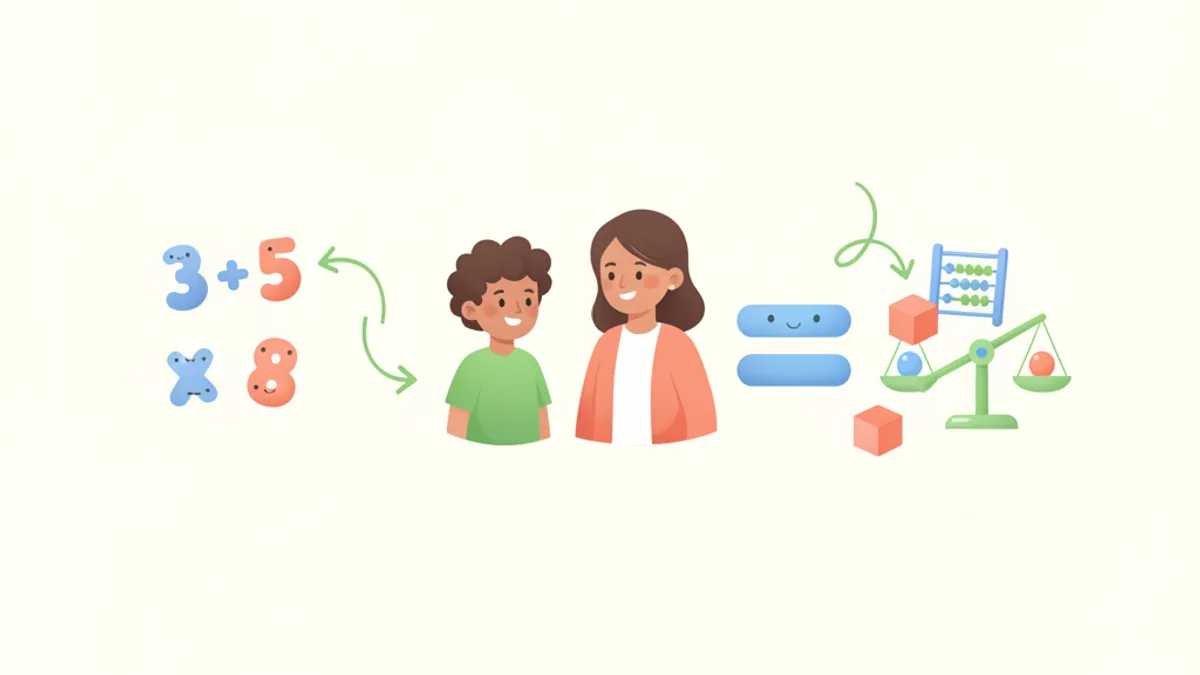
The commutative property states that the order of the numbers does not affect the result when adding or multiplying.
For addition: 3 + 5 produces the same result as 5 + 3. Both equal 8.
For multiplication: 4 times 7 produces the same result as 7 times 4. Both equal 28.
This sounds simple to the point of being obvious. But its implications are not simple, and children who understand it use it constantly without necessarily knowing they are doing so.
The most immediately practical implication is for multiplication fact learning. Without the commutative property, a child would need to learn each multiplication fact twice: once as 4 times 7 and separately as 7 times 4. With the commutative property, understanding that these are the same fact reduces the number of distinct facts to learn by nearly half. A child who understands why this is true, who knows that multiplication as equal groups means four groups of seven and seven groups of four produce the same total because the total number of objects is the same either way, has a conceptual handle on the fact rather than just two separate items to memorize.
The commutative property also underlies the mental calculation strategy of choosing the more convenient order for an operation. A child adding 2 + 47 who knows they can think of it as 47 + 2 and count on two is using the commutative property. A child multiplying 25 times 4 who recognizes they can think of it as 4 times 25, which equals 100, is using it with multiplication.
Crucially, the commutative property does not apply to subtraction or division. The order of numbers in subtraction does matter: 8 minus 3 is not the same as 3 minus 8. A child who grasps why the commutative property works for addition and multiplication, and why it fails for subtraction and division, has understood something genuinely deep about the structure of arithmetic.
The Associative Property: Grouping Does Not Matter for Addition and Multiplication
The associative property states that the way numbers are grouped when adding or multiplying does not affect the result.
For addition: (2 + 3) + 4 produces the same result as 2 + (3 + 4). Both equal 9.
For multiplication: (2 times 3) times 4 produces the same result as 2 times (3 times 4). Both equal 24.
The practical significance of this property is enormous, and it operates invisibly in the mental calculation strategies that mathematically confident people use automatically.
When a child adds 7 + 8 + 3 by first adding 7 and 3 to get 10, then adding 8 to get 18, they are using the commutative and associative properties together to reorder and regroup the addition. The fact that they can choose which numbers to combine first, based on which is most convenient, is guaranteed by these two properties.
The standard algorithm for multi digit addition is an application of both the associative and commutative properties: it works by grouping the calculation according to place value, adding ones to ones and tens to tens and hundreds to hundreds, which is possible because the associative property allows us to regroup the calculation without changing the result.
Mental multiplication with larger numbers depends heavily on the associative property. Calculating 4 times 25 as 4 times 5 times 5, arriving at 20 times 5, which equals 100, is an associative regrouping. The original expression has been rewritten as an equivalent expression that is easier to calculate.
Again, the property does not apply to subtraction and division, and this non application is itself mathematically meaningful.
The Distributive Property: The Most Powerful of the Three
The distributive property describes the relationship between multiplication and addition: multiplying a number by a sum is the same as multiplying the number by each part of the sum and then adding the results.
In formal notation: a times (b + c) equals (a times b) plus (a times c).
In a concrete example: 4 times 13 equals 4 times 10 plus 4 times 3, which equals 40 plus 12, which equals 52.
This property is the driver behind virtually every mental multiplication strategy that adults use. When a person calculates 7 times 48 by thinking 7 times 50 minus 7 times 2, they are applying the distributive property. When a child calculates 6 times 7 by thinking 6 times 5 plus 6 times 2, they are applying it. When a student multiplies a two digit number by a one digit number by multiplying the tens and ones separately and adding the results, they are applying it.
The distributive property is also the entire basis of the standard multiplication algorithm for multi digit numbers. When a child multiplies 47 by 6 using the standard algorithm, they are, step by step, calculating 6 times 7 and 6 times 40 and adding the results. The algorithm obscures this structure by encoding it in a series of steps rather than making it explicit, which is why children who learn only the algorithm often cannot explain why it works.
The distributive property connects multiplication to addition in a way that makes both operations more flexible. It is also the foundational property of algebra: the ability to expand and factor algebraic expressions, which is central to all of algebra, is a direct application of the distributive property with variables in place of specific numbers.
Why These Properties Are Not Just Vocabulary to Memorize
The names of these properties appear in mathematics standards and curriculum materials, and children are often expected to be able to identify them by name. This identification exercise, while not entirely without value, misses the point of what these properties are for.
They are not vocabulary items. They are structural features of the number system that make flexible mathematical thinking possible. A child who has memorized the names but does not understand the properties has learned three words. A child who understands the properties but does not know the names has a toolkit that will serve them through the rest of their mathematical education.
The goal is for a child to be able to look at a calculation that seems hard and see, without necessarily naming what they are doing, that there is a more convenient way to group the numbers, or a way to break one number apart to make the calculation easier, or a way to change the order to take advantage of a known fact. That seeing is what the properties enable.
How to Make These Properties Visible at Home
The most effective way to make these properties real is to make them visible in concrete contexts rather than presenting them as abstract rules.
For the commutative property: arrange eight objects in four groups of two, count them, rearrange into two groups of four, count again. The physical rearrangement and the consistent result make the property viscerally real.
For the associative property: add three numbers in two different orders and observe the same result. Ask which order was easier and why. The conversation about ease of calculation is the practical application of the property.
For the distributive property: calculate something like 6 times 13 by breaking the 13 into 10 and 3, calculating 6 times 10 and 6 times 3 separately, and adding. Then compare to the direct calculation. The equivalence of the results, arrived at by such different paths, is mathematically striking and practically useful.
These demonstrations do not need to happen in formal lesson contexts. They happen most naturally in the moments when a calculation arises in daily life and there is time to try it more than one way.
The role of mathematical properties in arithmetic understanding National Research Council. (2001). Adding It Up: Helping Children Learn Mathematics. National Academy Press. The NRC's synthesis of mathematics learning research identifies understanding of mathematical properties as a component of conceptual understanding that is essential for genuine mathematical proficiency and cannot be replaced by procedural fluency alone.
The distributive property as a foundation for algebra Kaput, J. J. (1999). Teaching and learning a new algebra. In E. Fennema and T. A. Romberg (Eds.), Mathematics Classrooms That Promote Understanding (pp. 133 to 155). Lawrence Erlbaum Associates. Kaput's analysis of algebra readiness identifies understanding of the distributive property in arithmetic as one of the most critical prerequisites for algebraic thinking, establishing the importance of making this property explicit in elementary instruction.
Properties and flexible mental calculation Sowder, J. T. (1992). Estimation and number sense. In D. A. Grouws (Ed.), Handbook of Research on Mathematics Teaching and Learning (pp. 371 to 389). Macmillan. Sowder's review of mental calculation research documents how understanding of mathematical properties underlies the flexible mental calculation strategies that distinguish fluent mathematical thinkers from those who depend entirely on standard algorithms.
Making mathematical structure visible to children Carpenter, T. P., Franke, M. L., and Levi, L. (2003). Thinking Mathematically: Integrating Arithmetic and Algebra in Elementary School. Heinemann. This research based text documents how making mathematical properties explicit in elementary instruction, including the commutative, associative, and distributive properties, builds the relational thinking that is foundational to algebraic reasoning.
The standard algorithm as an application of mathematical properties Fuson, K. C., and Beckmann, S. (2012). Standard algorithms in the Common Core State Standards. National Council of Supervisors of Mathematics Journal of Mathematics Education Leadership, 14(2), 14 to 30. This analysis of standard arithmetic algorithms documents how each algorithm is an application of mathematical properties, particularly the distributive property and place value, providing the research basis for teaching algorithms with explicit connection to the properties they employ.
Commutativity and multiplication fact learning Baroody, A. J. (2006). Why children have difficulties mastering the basic number combinations and how to help them. Teaching Children Mathematics, 13(1), 22 to 31. Baroody's analysis of multiplication fact acquisition documents how understanding of the commutative property reduces the effective number of facts to be learned and how teaching this understanding alongside the facts produces more flexible and durable fact knowledge.