The case against flashcards is not that they do not work. Used with proper spaced practice and active retrieval, they work reasonably well. The case against flashcards is that most children will not use them voluntarily for more than a few minutes, which limits the amount of retrieval practice that actually happens.
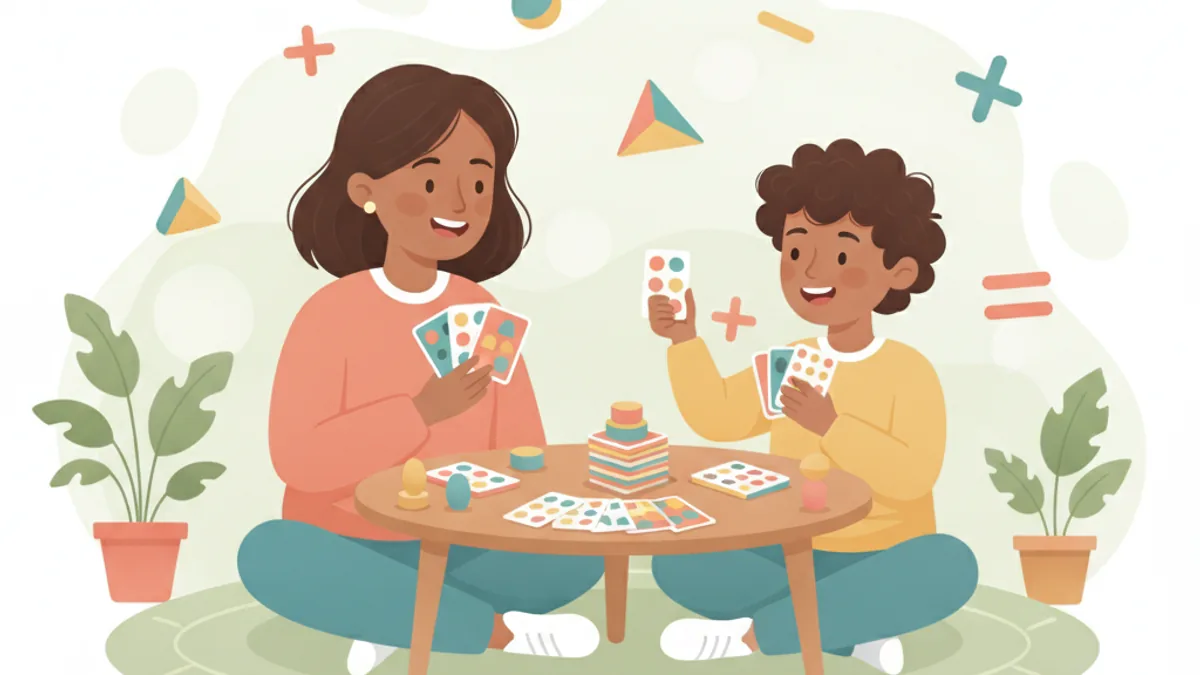
A child who plays a mathematics card game for twenty minutes and a child who does twenty minutes of flashcard practice receive approximately the same amount of mathematical retrieval practice. But the card game child often returns to the game willingly the next day, while the flashcard child requires varying levels of persuasion. Over weeks and months, this difference in voluntary engagement produces a dramatic difference in total practice time, and total practice time, distributed across many sessions, is what builds genuine mathematical fluency.
The card games in this guide are selected based on two criteria: the mathematical thinking they require is genuine and is necessary for successful play, not decorative, and children find them engaging enough to play voluntarily beyond the initial novelty period. Both criteria matter. A game that a child plays enthusiastically for two weeks and then abandons has served its purpose less well than a game that is played less intensely but returned to regularly over months.
Games with a Standard 52 Card Deck
A standard card deck is the most versatile mathematical game tool available. It costs almost nothing, is found in most homes, and can generate dozens of different mathematical activities depending on how it is configured and what rules govern play.
For the games below, number cards are used at face value. Face cards (jack, queen, king) can be assigned values of 11, 12, and 13 for games requiring numbers above ten, or removed for games that work better with numbers one through ten. Aces typically count as one.
Addition War
Two players split the deck evenly. Each player flips two cards simultaneously. The player whose two cards sum to the larger total takes all four cards. Play continues until one player has all the cards or time is called.
The mathematical practice this produces is extensive: each round requires a two number addition, and the game proceeds quickly enough to produce dozens of addition calculations in a short session. For children working on addition within twenty, using face cards removed or aces through tens only, the practice is perfectly calibrated. For children working on larger sums, face cards can be included.
A multiplication variant: each player flips two cards and multiplies them. The player with the larger product wins the round. This variant produces multiplication fact practice with exactly the competitive structure that motivates sustained engagement.
Go Fish for Tens
This variant of Go Fish requires players to collect pairs of cards that sum to ten rather than pairs of cards with the same face value. A player holding a three asks another player: "Do you have a seven?" Because three plus seven equals ten. A player holding a two asks for an eight.
This game produces systematic practice with the number bonds to ten, which are the most foundational arithmetic facts in elementary mathematics. The game format means the practice is genuinely motivated by the desire to collect pairs rather than by the requirement to practice facts, which produces more focused and more willing engagement.
Closest to One Hundred
Each player draws four cards and arranges them as two two digit numbers to make a sum as close to one hundred as possible without exceeding it. A player with cards showing 2, 3, 4, 6 might arrange them as 42 and 63 for a sum of 105 (over), or as 36 and 42 for 78, or as 64 and 32 for 96. The player closest to 100 without exceeding it wins the round.
This game produces flexible two digit addition practice and requires strategic thinking about how numbers can be arranged to produce a target sum. The strategic element is what sustains engagement past the novelty period: children who want to win continue to think carefully about the best arrangement, which is exactly the flexible numerical reasoning the game is designed to build.
Twenty One Variations
Standard blackjack rules, simplified, produce excellent addition practice with strategic depth. Players try to accumulate cards whose sum is as close to twenty one as possible without exceeding it. Each decision, whether to take another card or stay, requires estimating the current total and the risk of busting.
For younger children, reduce the target to eleven and use only ace through six cards. The mathematical content is the same. The scale is more appropriate.
Make Ten Speed
Lay cards face up in a grid. Players simultaneously look for pairs of cards that sum to ten and remove them from the grid. When no more pairs remain, new cards are flipped. The player who removes the most pairs wins.
This game produces rapid, competitive practice with the tens bonds in a format that rewards both mathematical knowledge and visual scanning speed. Children who know their tens bonds have a genuine advantage over those who do not, which motivates fluency development in a way that few drill formats match.
Games with Specialized Card Decks
Sleeping Queens
Described in the board games article in this series, Sleeping Queens lets players discard number cards that make an addition equation, such as a two, a three and a five, to draw fresh cards, while King cards wake the queens. The arithmetic is genuine, useful, and constantly varied as the cards in hand change.
The flexibility it produces, the habit of looking at a set of numbers and asking which of them combine to make another, is a form of mathematical thinking that drill does not build.
Sushi Go
Sushi Go is a card drafting game in which players collect sets of themed cards across three rounds. While not explicitly a mathematics game, it involves constant addition of score values across rounds, fraction reasoning in how best to allocate cards across sets, and strategic thinking about which combinations produce the highest totals. Children who play it regularly practice mental addition in a context of genuine strategic engagement.
Rat a Tat Cat
Rat a Tat Cat is a memory and strategy game in which players try to minimize the total value of their hand. Players draw cards, compare values, and decide whether to replace higher valued cards with lower valued ones. The game requires constant numerical comparison and mental addition to track the estimated total of a hand.
The memory element adds a second cognitive layer that makes the game more engaging than pure arithmetic practice. Children who are tracking both the cards they have seen and the strategic implications of their hand composition are doing considerable mathematical work without experiencing it as mathematical practice.
How to Use These Games for Maximum Benefit
Play frequently in short sessions rather than occasionally in long ones. The spacing effect applies to game based practice as much as to any other form. Three twenty minute game sessions across a week produce better fact retention than one hour long session, because the gaps between sessions allow consolidation to occur.
Vary the games rather than playing the same one repeatedly. Different games produce different mathematical encounters with the same facts. A child who has played multiplication war, Sleeping Queens, and close to one hundred in the same week has encountered number facts in three different competitive contexts, which produces broader and more flexible retrieval than the same game played three times.
Discuss the mathematics occasionally, not constantly. A game that is interrupted every two minutes to discuss the underlying mathematics loses its status as a game and becomes a thinly disguised lesson. Occasional, natural mathematical observations, "did you notice that five plus five always shows up together?" or "you were clever to break the eleven into ten and one there" are enough to make the mathematical content visible without disrupting the play.
Play at a level that is genuinely challenging. Games that are too easy produce no mathematical development. Games that are too hard produce frustration that ends the session. The right level is where the child is making meaningful decisions and occasionally losing, which maintains engagement and produces the retrieval practice that builds fluency.
Game based learning and mathematical fact fluency Bragg, L. A. (2012). Testing the effectiveness of mathematical games as a pedagogical tool for children's learning. International Journal of Science and Mathematics Education, 10(6), 1445 to 1467. This study found that well designed mathematical games, where mathematical thinking is necessary for success, produced genuine fluency development alongside positive attitudes toward practice.
Intrinsic motivation and voluntary practice Deci, E. L., and Ryan, R. M. (1985). Intrinsic Motivation and Self Determination in Human Behavior. Plenum. Deci and Ryan's self determination theory establishes the conditions under which activities are pursued voluntarily, including autonomy, competence building, and genuine engagement, providing the theoretical basis for preferring game based over drill based practice when voluntary engagement is the goal.
The spacing effect applied to game based practice Cepeda, N. J., Pashler, H., Vul, E., Wixted, J. T., and Rohrer, D. (2006). Distributed practice in verbal recall tasks: A review and quantitative synthesis. Psychological Bulletin, 132(3), 354 to 380. This comprehensive review of the spacing effect provides the evidence base for recommending short, frequent game sessions over occasional long ones, with the spacing applying equally to game based and drill based practice.
Number bonds to ten and their role in arithmetic fluency Baroody, A. J., Bajwa, N. P., and Eiland, M. (2009). Why can't Johnny remember the basic facts? Developmental Disabilities Research Reviews, 15(1), 69 to 79. This review establishes the foundational role of the number bonds to ten in arithmetic fluency development, providing the evidence base for games specifically designed to practice these bonds.
The role of competition in motivating mathematical practice Kamii, C., and Anderson, C. (2003). Multiplication games: How we made and used them. Teaching Children Mathematics, 10(3), 135 to 141. This classroom research documented how competitive game contexts motivated more sustained and more willing mathematical practice than non competitive formats, particularly for fact fluency development.
Retrieval practice in game contexts Roediger, H. L., and Butler, A. C. (2011). The critical role of retrieval practice in long term retention. Trends in Cognitive Sciences, 15(1), 20 to 27. This review of retrieval practice research established that active retrieval in any context, including game contexts, produces better long term retention than passive exposure, supporting the use of card games as a genuine form of productive retrieval practice.