
The People Who Read the Sea
How do you find an island you have never seen, in an ocean with no signposts?
Who is in this story
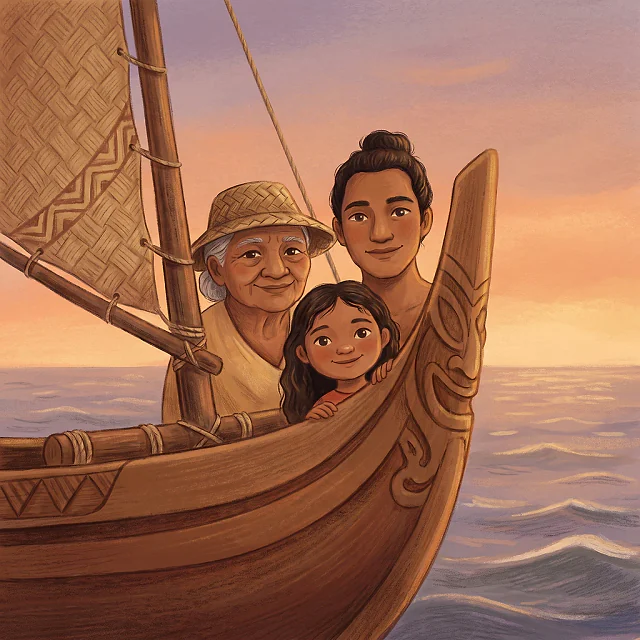
The wayfinders
They crossed the biggest ocean on earth with no instruments at all.
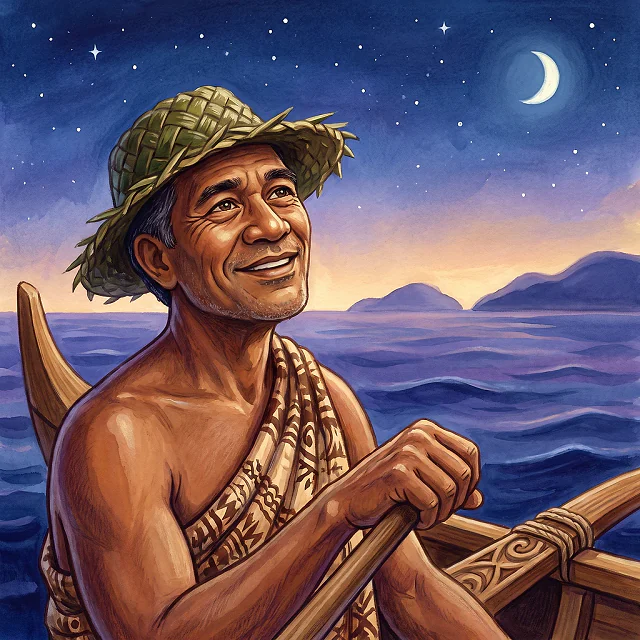
Mau Piailug
A master navigator from Satawal who said yes to somebody else's ocean.
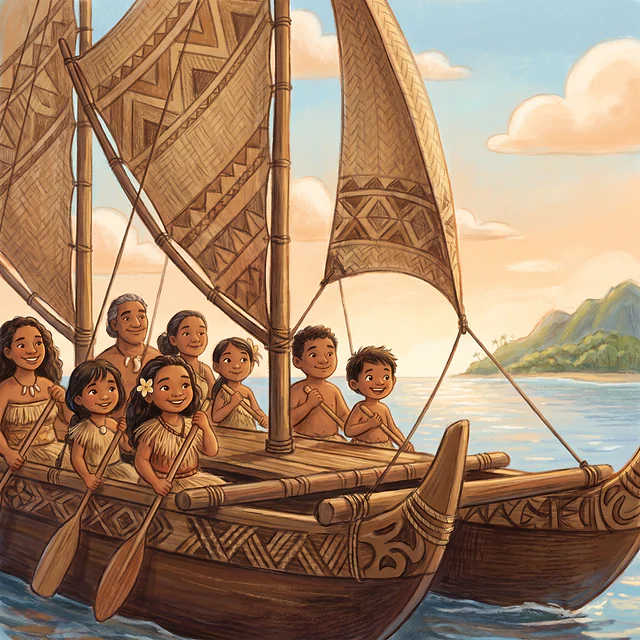
Nainoa
The Hawaiian who learned the old way and sailed it home.
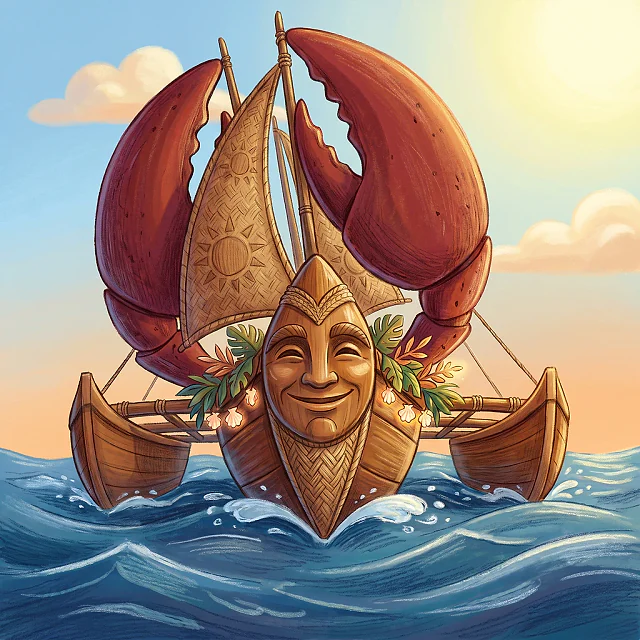
Hokule'a
The canoe they built the old way, to prove it could be done.
Read the rest of this story
Start free and your children read it under your account, with the worksheets and the films.
The People Who Read the Sea
How do you find an island you have never seen, in an ocean with no roads, no signposts and no edges?
You cannot see it. It is too far away. It is smaller than a full stop on a page the size of a country. And you are in a boat.
People did this. Not once, by luck. Again and again, for hundreds of years, all across the biggest ocean on earth.
They were the peoples of the Pacific. They are called wayfinders.
They built canoes with two hulls joined together and a sail between. Big enough to carry families, pigs, chickens, and young plants wrapped in damp leaves. Everything you would need to start again somewhere new.
Then they sailed out past the last thing they could see.
They had no compass. No maps. No clocks. Nothing with a needle or a screen.
What they had was everything else.
They knew the stars. Not a few of them. All of them.
A navigator learned which star rises at which notch on the horizon. He learned the order they follow, all night long. The whole turning sky became a compass he carried in his head.
They knew the sea itself. Out in the deep ocean, long slow swells roll for thousands of miles, always from the same directions.
A navigator could lie down in the bottom of the canoe and feel those swells through the hull. The hull is the wooden skin of the boat. He could tell whether they were still crossing them at the right angle. He could steer in the dark, in cloud, by feel.
They knew birds. Some seabirds fly far out to fish in the morning and go home to land at dusk. Follow one home in the evening and it will take you somewhere.
They knew clouds. A cloud sitting still while others drift is often sitting on top of an island.
And a lagoon is the shallow bright water inside a ring of reef. A lagoon can throw a faint green light up onto the clouds above it. So a navigator could see the colour of an island before he could see the island.
Picture one night out there. No land for a week. A boy holds the steering paddle while the navigator lies flat in the bottom of the canoe with his eyes shut.
He is not sleeping. He is counting the swells against his back. One long one from the east. A shorter one underneath it, from the south. Still the right angle. Still the right way.
He does not open his eyes.
"Hold her there," he says.
And the boy holds her there, all night, in the dark, on the word of a man lying on his back.
They knew all of this by heart, because none of it was written down. It was taught. Grandparent to parent to child, chanted, tested, remembered. A whole science, carried entirely in people.
That is how they found Hawaii. And Tahiti, and Samoa, and Rapa Nui, and finally Aotearoa, far to the south. Island after island after island, across an ocean that covers a third of the world.
Now here is the sad part.
Time passed. Ships came from other places. People stopped making the great voyages, and stopped teaching the knowledge. And slowly, the way anything stops when nobody passes it on, it faded.
By the time your great grandparents were young, nobody in Hawaii knew how to do it any more.
Some people did not believe it had been done on purpose. They said the islands must have been found by accident, by canoes blown off course. They said nobody could cross that ocean deliberately without instruments.
"You cannot do it," they said. "Not without instruments. Not on purpose."
So in 1976, three men in Hawaii, an artist, a scientist and a sailor, decided to settle it.
They built a voyaging canoe the old way and called her Hokule'a. They would sail her from Hawaii to Tahiti, about two thousand four hundred miles, with no instruments of any kind.
There was one problem. They had the canoe. They did not have anyone who could navigate her.
And this is my favourite part of the whole story.
They found a man called Mau Piailug. Mau was a master navigator, one of the last, and he was not Hawaiian at all.
He came from a tiny island called Satawal, thousands of miles away in Micronesia, where the teaching had never been broken.
It was not his canoe. It was not his island. It was not his ocean to cross.
Mau said yes anyway.
He sailed Hokule'a to Tahiti with no compass and no charts. He read the stars and the swells and the birds, exactly as it had been done for a thousand years. It took him about a month.
When the canoe came in, more than seventeen thousand people were waiting on the beach in Tahiti. More than half the island.
"She's here," somebody shouted from the water. "She's actually here."
So many children climbed onto the back of her that the stern went down into the water.
And Mau did something even bigger afterwards. He taught.
He passed the knowledge on to a young Hawaiian named Nainoa Thompson. Through him, it came back to the people it had come from.
The stars had not gone anywhere. The swells had not stopped. All that had ever been missing was somebody willing to teach, and somebody willing to learn.