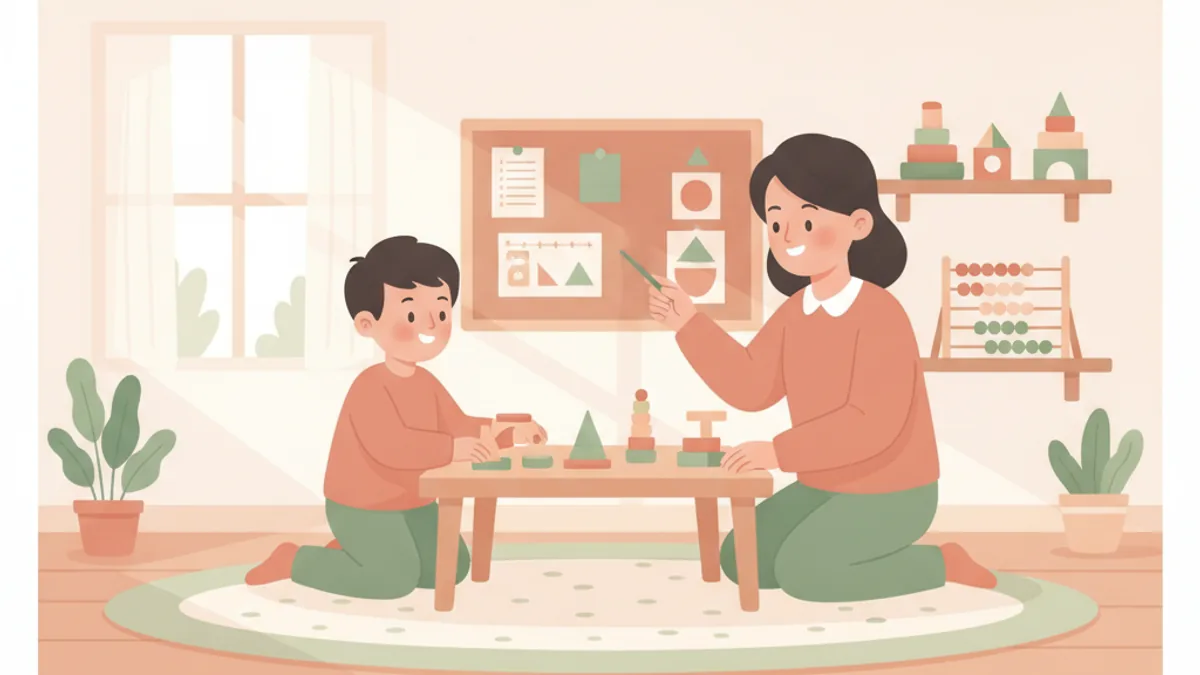
One of the most consistent findings in research on children's learning environments is that the physical space where learning happens shapes the learning itself. Not metaphorically. Literally. Children are more likely to engage independently with mathematical materials when those materials are visible, accessible, organized, and located in a space that the child associates with enjoyable exploration rather than required work.
A math corner is a simple and low cost way to create exactly this kind of environment. It is a designated area in your home where mathematical materials live permanently, are organized so that a child can find and return anything without help, and are selected to invite the kind of mathematical thinking you want your child to develop.
The difference between a math corner that children use voluntarily and one that sits ignored is almost entirely in the design decisions: what goes in it, how it is organized, where it is located, and how it is introduced. These decisions are not complicated, but they are consequential, and they are worth making deliberately.
The Principle Behind a Math Corner
The core principle is environmental design for independent use.
Most mathematical materials in homes are stored in ways that require adult involvement to access: in a cabinet, in a bin on a high shelf, in a closet where they are retrieved for formal lessons and returned when the lesson is done. This storage pattern makes mathematical materials feel like lesson materials, which children associate with required work rather than voluntary exploration.
A math corner inverts this pattern. Materials are permanently displayed and accessible. The child can go to the corner independently, take something out, use it, and put it back without asking permission or assistance. This accessibility changes the child's relationship to the materials from passive recipient to active user.
Educators in the Montessori and Reggio Emilia traditions have long observed that environments designed for independent child access produce more self directed exploration and more sustained engagement than environments where adults control the materials. The child who chooses to pick up a set of pattern blocks and begin building is in a qualitatively different cognitive state from the child who is handed pattern blocks and told to use them.
Where to Locate It
The math corner does not need a dedicated room or even a large space. What it needs is a specific, consistent location that the child comes to associate with mathematical exploration.
Ideal characteristics:
Visible from common areas where the child spends time. If the corner is in a room the child rarely enters, the materials will not capture attention and the corner will go unused.
At the child's level. Shelves and surfaces should be at a height where the child can see and reach everything without adult assistance. Materials on high shelves or in deep bins are not independently accessible in any practical sense.
Physically distinct from the television, gaming area, or other entertainment spaces. The math corner should not compete with higher stimulation activities for attention. A quiet corner of a living room, a dedicated section of a play area, or a homeschool workspace are better choices than a corner adjacent to a screen.
Large enough for the core materials and a small working surface. A child who takes out pattern blocks needs somewhere to arrange them. A corner without any working surface becomes frustrating quickly.
A bookshelf with three or four shelves, a small table or the floor immediately in front of it, and a wall or corner location for organization is sufficient for most families.
What to Put in It
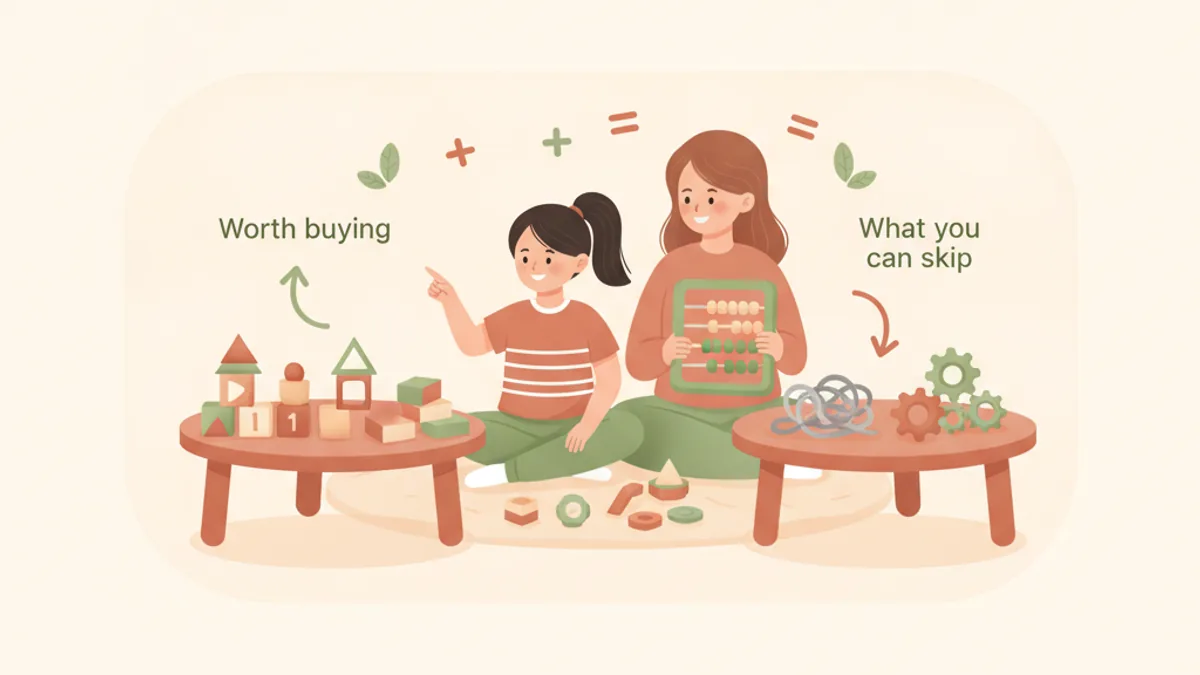
The contents of a math corner should be selected according to a single criterion: will a child pick this up spontaneously and engage with it for more than a few minutes? That criterion rules out most formal curriculum materials and worksheets, which children associate with assigned work, and highlights the materials that invite exploration.
Core manipulatives that invite independent use:
Pattern blocks are the single most self sustaining material available for a math corner. Children of a wide age range pick them up spontaneously and build with them for extended periods, and the mathematical content of what they build, symmetry, spatial reasoning, geometric relationships, is substantial. Pattern blocks earn their shelf space.
Base ten blocks, available at the child's level with a laminated place value mat to work on, invite number exploration and representation in children who are working with place value.
A set of dice in multiple sizes and configurations: standard six sided, ten sided, twelve sided, twenty sided. Dice invite spontaneous games and calculation. A child who picks up two dice and rolls them is almost certainly going to add or multiply the results, and they are doing this voluntarily.
Colored tiles or cubes for building and counting. The three dimensional nature of stacking and building engages spatial reasoning in a form that flat materials do not.
A small abacus for the youngest children, who are often drawn to moving the beads and counting as they do.
Tools that make mathematics feel like real work:
A child sized ruler, measuring tape, and protractor. Children who see real measurement tools in their environment use them on real objects in their environment. Measurement activities that arise from genuine curiosity, how wide is this book, how tall am I, what angle does this ramp make, are mathematically richer than worksheet measurement exercises.
A calculator. Not to replace calculation, but to allow exploration of patterns and large numbers that would be inaccessible without one. A child who discovers on their own that 111 times 111 equals 12321, and that this is part of a pattern, has encountered an interesting mathematical idea through voluntary exploration.
Graph paper and dot paper alongside pencils and colored markers. These materials invite children to draw their own arrays, create their own patterns, and represent their own mathematical ideas.
Books:
Three or four mathematical picture books appropriate to the child's age, rotated every few months to maintain novelty. Books like those by Marilyn Burns, Greg Tang, and Stuart Murphy connect mathematics to story in a way that invites voluntary reading. A child who picks up a mathematical picture book because it looks interesting is encountering mathematical ideas in the most voluntary possible context.
A mathematics puzzle book appropriate to the child's level. Logic puzzles, KenKen, Sudoku, and visual spatial puzzles are mathematical activities that children pursue voluntarily when they are engaging enough and accessible enough.
What Not to Put in It
Worksheets, even interesting ones, belong in the lesson space rather than the exploration corner. The child who picks up a worksheet spontaneously will likely feel that they have accidentally assigned themselves homework, and the corner will lose its status as a voluntary exploration space.
Formal curriculum materials signal that this is a work space rather than an exploration space. Keep the curriculum in its own location.
Too many materials. A corner with thirty different types of material is overwhelming and produces paralysis rather than engagement. Fewer options, displayed clearly, produce more use than more options stored densely. Rotate materials every few months to maintain novelty without accumulating clutter.
Materials in closed containers. Anything that requires opening a box or bin to see what is inside is less likely to be used than materials that are visible and immediately graspable. Display materials on open shelves with labels or pictures so that everything is visible and identifiable at a glance.
How to Introduce It
The worst way to introduce a math corner is to announce it as a place for math practice. The best way is to introduce it as a place with interesting things in it.
Bring a child to the corner, pick up something that you find genuinely interesting, and engage with it yourself for a few minutes. Not performing interest for the child's benefit, but actually engaging. Children are drawn to what adults find interesting, and an adult who is genuinely absorbed in building a pattern block design or rolling dice and recording the results communicates something about the corner that no announcement can.
Then leave them to it. Do not assign a task, do not suggest what to do with the materials, do not supervise. Come back in fifteen minutes.
The goal is for the child to discover, through their own experience, that this corner contains things worth engaging with. That discovery is more durable and more motivating than any instruction you could provide.
Maintaining It Over Time
A math corner requires maintenance to remain inviting. Without maintenance, it becomes a corner of neglected materials that the child walks past without noticing.
Rotate materials every four to six weeks. Put some things away and bring out others that have been in storage. The reappearance of something not seen for two months is nearly as engaging as encountering something new.
Replenish consumables. Graph paper, pencils, and markers run out. A corner with depleted materials signals that no one is attending to it.
Add something new occasionally. A new puzzle book, a new type of manipulative, or a new mathematical game that appears in the corner without announcement invites investigation.
And use it yourself. An adult who occasionally sits in the corner with materials is communicating, more effectively than any words could, that this is a space worth inhabiting.
Environmental design and children's independent learning Montessori, M. (1912). The Montessori Method. Frederick A. Stokes Company. Montessori's foundational work on the prepared environment established the principle that the physical arrangement and accessibility of materials shapes the quality and independence of children's learning, providing the theoretical basis for deliberate learning environment design.
The Reggio Emilia approach to learning environments Gandini, L. (1993). Fundamentals of the Reggio Emilia approach to early childhood education. Young Children, 49(1), 4 to 8. This overview of the Reggio Emilia approach documents its conception of the environment as a third teacher, alongside the child and the educator, and provides a framework for understanding how physical environments can be designed to invite independent exploration and mathematical thinking.
Choice and intrinsic motivation in learning Deci, E. L., and Ryan, R. M. (1985). Intrinsic Motivation and Self Determination in Human Behavior. Plenum. Deci and Ryan's self determination theory establishes autonomy, including the freedom to choose one's activity, as a core psychological need whose satisfaction produces intrinsic motivation, providing the theoretical basis for the value of voluntary access to mathematical materials.
The physical environment and mathematical learning Clements, D. H. (2001). Mathematics in the preschool. Teaching Children Mathematics, 7(5), 270 to 275. Clements describes how young children's everyday play with blocks, shapes and materials is full of mathematics, and how adults can set up the environment and join in to draw it out.
Manipulatives and voluntary mathematical exploration Moyer, P. S. (2001). Are we having fun yet? How teachers use manipulatives to teach mathematics. Educational Studies in Mathematics, 47(2), 175 to 197. This study of how teachers use manipulatives found that many treated them as a fun extra rather than as a way to think, a reminder that materials do mathematical work only when children use them to reason.
Mathematical picture books and voluntary engagement with mathematical ideas Van den Heuvel Panhuizen, M., and Elia, I. (2012). Developing a framework for the evaluation of picturebooks that support kindergartners' learning of mathematics. Research in Mathematics Education, 14(1), 17 to 47. This research on mathematical picture books documented their effectiveness at engaging children with mathematical ideas in a voluntary, narrative context, supporting their inclusion in a home math corner alongside manipulatives.