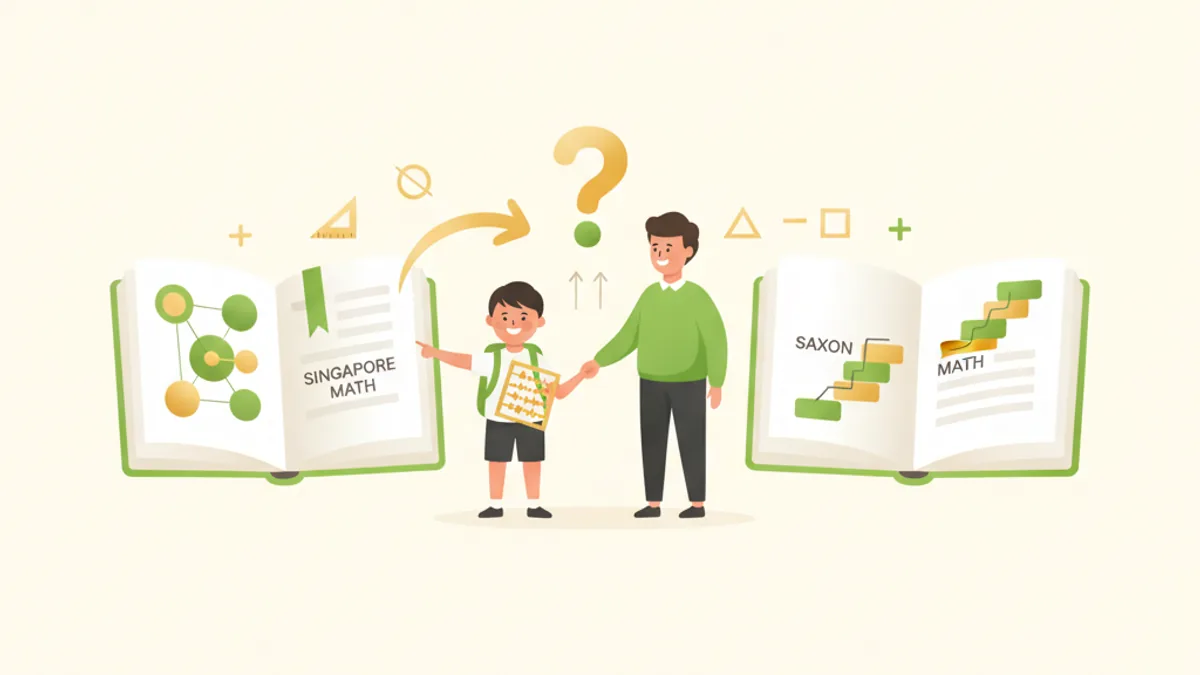

The decision about whether to purchase a mathematics curriculum for homeschooling is, for many families, primarily a financial one. Mathematics curricula range from free to several hundred dollars per year per child, and the upper end of that range represents a meaningful expense, particularly for families with multiple children or limited budgets.
But the decision is also a quality one, and the relationship between price and quality in mathematics curriculum is neither consistent nor predictable. Some of the most expensive curricula have significant pedagogical weaknesses. Some of the most effective approaches cost nothing. And the right choice for any particular family depends on factors that have nothing to do with price: the child's learning profile, the parent's mathematical background, the family's approach to homeschooling, and what the curriculum is being asked to do.
This guide is honest about where free resources are genuinely sufficient and where paying for a well designed curriculum represents a worthwhile investment.
What Free Resources Actually Provide
Khan Academy
Khan Academy is the most comprehensive free mathematics resource available, and for many homeschooling families it is a complete and sufficient primary curriculum through middle school mathematics. It provides video instruction for every topic from kindergarten through calculus, practice problems with immediate feedback, a progress tracking system, and a structured sequence that follows a coherent scope and sequence.
Its strengths are substantial. The video instruction is clear and accessible. The practice system adapts to a child's performance, offering easier problems when a child struggles and harder ones when they succeed. It is self paced, which is one of the most important features for homeschooling. And it costs nothing.
Its limitations are also real. The instruction is primarily procedural: Khan Academy is very good at explaining how to do mathematics and less strong at building the conceptual understanding of why procedures work. It is almost entirely abstract and symbolic, with limited concrete and pictorial representation of the kind that research consistently identifies as foundational for genuine mathematical understanding. And it requires self direction from the child, which is not equally available at all ages and for all learning profiles.
For a mathematically capable, self directed older child, Khan Academy can be a complete primary curriculum. For a younger child, or a child who needs extensive concrete experience before symbolic work, it works better as a supplement than as a primary resource.
Beast Academy Online
Beast Academy Online is a paid subscription, not a free program. It does offer a free online demo where you can try sample lessons, puzzles and videos, which is a good way to see whether this style of challenging, puzzle based mathematics suits your child before paying. For mathematically capable children it is a high quality enrichment option.
Prodigy and similar game based platforms
Prodigy and similar platforms offer free access to game based mathematics practice. These platforms are more effective at sustaining practice engagement than at building mathematical understanding, and they are best thought of as fluency practice tools rather than curriculum. The research on game based learning suggests they are most valuable when the mathematical content is genuinely embedded in the gameplay rather than attached to it as a reward for non mathematical activities.
Free printable resources
Numerous websites offer free printable mathematics worksheets, activity sheets, and curriculum guides. The quality varies enormously. The best of these resources are produced by curriculum developers who offer some content free as samples of paid materials. The weakest are worksheet generators that produce computation practice without any conceptual development.
For targeted practice on specific skills, well chosen free printables are entirely sufficient. For building mathematical understanding systematically, they are not.
What Paid Curricula Provide That Free Resources Usually Do Not
The features that distinguish the best paid mathematics curricula from free resources fall into a few consistent categories.
Coherent scope and sequence with deliberate conceptual progression. A well designed paid curriculum has made explicit decisions about the order in which concepts are introduced, the connections that are built between them, and the pace at which a child moves from concrete to pictorial to abstract. These decisions are the result of substantial research and development, and they are evident in how a curriculum feels to use: coherent, purposeful, and progressive rather than a collection of isolated topics.
Extensive teacher and parent support. The best paid curricula include detailed guidance for the adult delivering instruction. Not just answer keys, but explanations of why each concept is taught the way it is, what common misconceptions to watch for, how to identify when a child needs more time, and what to do when difficulties arise. This teacher support is where most of the investment in curriculum development goes, and it is where the quality difference between well funded and poorly funded curricula is most visible.
Multi sensory and multi representational instruction. Curricula that systematically move through concrete, pictorial, and abstract representations, with purpose built materials and diagrams for each, require significant development investment. Free resources rarely include purpose built physical manipulatives and coherent visual representation systems.
Mastery orientation with assessment. Curricula that include built in assessment for each concept and explicit guidance on what mastery looks like before moving forward require development investment that most free resources do not reflect.
When Free Is Genuinely Sufficient
Free resources are genuinely sufficient in the following situations.
For families with a mathematically confident parent who can provide the conceptual instruction, questioning, and discussion that free resources do not. Khan Academy for procedural instruction plus a parent who asks "why does that work?" and "can you show me what that means?" plus a set of manipulatives for concrete experience is a complete and effective mathematics education.
For older children who are self directed and mathematically capable. A tenth grade student who needs calculus instruction and is self motivated to engage with Khan Academy videos and practice problems does not need a paid curriculum.
For supplementing a primary curriculum. Free resources are excellent for targeted additional practice, enrichment, and skill maintenance alongside a primary curriculum.
For families with limited budgets. There is no good evidence that paid curricula produce better outcomes than well used free resources. What a family does with a curriculum, and the mathematical conversation around it, matters at least as much as what it cost.
When Paying for a Curriculum Is Worth It
Paid curricula earn their cost in the following situations.
For families whose primary curriculum needs are conceptual depth and careful progression. Singapore Math, RightStart Mathematics, and Math U See are the most frequently recommended paid options, and their cost reflects the quality of their conceptual development and their parent support materials.
For children with learning differences who need instruction specifically designed for their profile. The specialized curricula described in the article on homeschool math for different learners cost money because developing them required significant expertise and testing.
For parents who are not mathematically confident and need the curriculum to carry the instructional weight. A parent who is uncertain about mathematics benefits from a curriculum that explains the mathematics clearly, anticipates common difficulties, and provides explicit guidance for every lesson.
For families who want a complete, structured program that requires minimal planning. Buying a well designed curriculum buys planning time: someone else has decided what to teach, in what order, at what pace, with what materials.
A Practical Decision Framework
Before spending money on a mathematics curriculum, answer these four questions.
What does my child specifically need that free resources do not currently provide? If the answer is concrete materials, look for curricula that include them. If the answer is conceptual depth, look for curricula known for that. If the answer is more practice, more free resources may solve the problem.
What is my own mathematical confidence level, and how much does the curriculum need to teach me as well as my child? A parent who needs to learn alongside their child benefits more from a curriculum with comprehensive teacher support than from a minimalist one.
Have I actually tried the best free resources before concluding that they are insufficient? Many families purchase paid curricula before genuinely implementing Khan Academy, which is a complete and coherent mathematics curriculum for most grade levels.
Can I access a sample or trial before committing to a full purchase? Most reputable paid curricula offer sample lessons, demo access, or placement tests. Using these before purchasing reduces the risk of buying a curriculum that turns out to be poorly matched to the child.
The effectiveness of Khan Academy as a mathematics learning resource Murphy, R., Gallagher, L., Krumm, A., Mislevy, J., and Hafter, A. (2014). Research on the Use of Khan Academy in Schools. SRI Education. This independent study of how schools used Khan Academy found that students who used it more tended to do better, and that schools used it mostly alongside teaching rather than in place of it.
The role of conceptual instruction in mathematics curriculum quality National Research Council. (2001). Adding It Up: Helping Children Learn Mathematics. National Academy Press. The NRC's synthesis of mathematics learning research provides the framework for evaluating curriculum quality, identifying conceptual understanding as a necessary component that procedural only curricula lack.
Parental engagement as a predictor of mathematical outcomes Patall, E. A., Cooper, H., and Robinson, J. C. (2008). Parent involvement in homework: A research synthesis. Review of Educational Research, 78(4), 1039 to 1101. This synthesis found that the kind of help parents give matters: structure and support help more than directing the work or doing it for the child, supporting the recommendation to invest in how you are involved, not only in what you buy.
Game based learning and mathematical fluency Bragg, L. A. (2012). Testing the effectiveness of mathematical games as a pedagogical tool for children's learning. International Journal of Science and Mathematics Education, 10(6), 1445 to 1467. This study examined conditions under which game based mathematics platforms produce genuine learning, finding effects strongest when mathematical thinking is genuinely required for gameplay success.
The concrete representational abstract progression in curriculum design Witzel, B. S., Mercer, C. D., and Miller, M. D. (2003). Teaching algebra to students with learning difficulties: An investigation of an explicit instruction model. Learning Disabilities Research and Practice, 18(2), 121 to 131. This research provides the evidence base for valuing curricula that systematically implement the CRA progression, one of the features that most clearly distinguishes high quality from lower quality mathematics curricula.
Homeschooling outcomes and curriculum choice Ray, B. D. (2010). Academic achievement and demographic traits of homeschool students: A nationwide study. Academic Leadership: The Online Journal, 8(1). This large scale study of homeschooling outcomes found strong academic achievement across a diverse range of curriculum choices, suggesting that implementation quality and parental engagement matter more than specific curriculum selection.